
TextAfrique is developing an African-first technology vision built around a simple principle: AI should not become useful only when the internet is available.
Across Africa, connectivity, electricity, device affordability, language diversity and computing infrastructure continue to shape who can participate fully in the digital economy. Recent research and industry work increasingly points toward edge and offline AI as one pathway for deploying intelligence closer to users and reducing dependence on continuous cloud connectivity.
For TextAfrique, this is more than a product feature. It is a long-term infrastructure blueprint.

2. Why Offline AI Matters
The future of AI cannot be built around connectivity alone.
The World Bank notes significant gaps in rural internet access and electricity availability across Sub-Saharan Africa, while the IMF has also identified infrastructure, connectivity and digital skills as important constraints on AI adoption.
This creates a fundamental question:
What happens when the connection disappears?
For a cloud-dependent application, the answer may be simple: functionality stops or becomes severely limited.
For an offline-first system, the architecture is different.
The device or local infrastructure can continue performing selected tasks, storing information securely and synchronising when connectivity becomes available.
That creates a different relationship between people and technology.
Connectivity becomes an accelerator—not the only gateway to intelligence.

3. The TextAfrique African Blueprint
TextAfrique’s long-term blueprint is built around several interconnected layers.
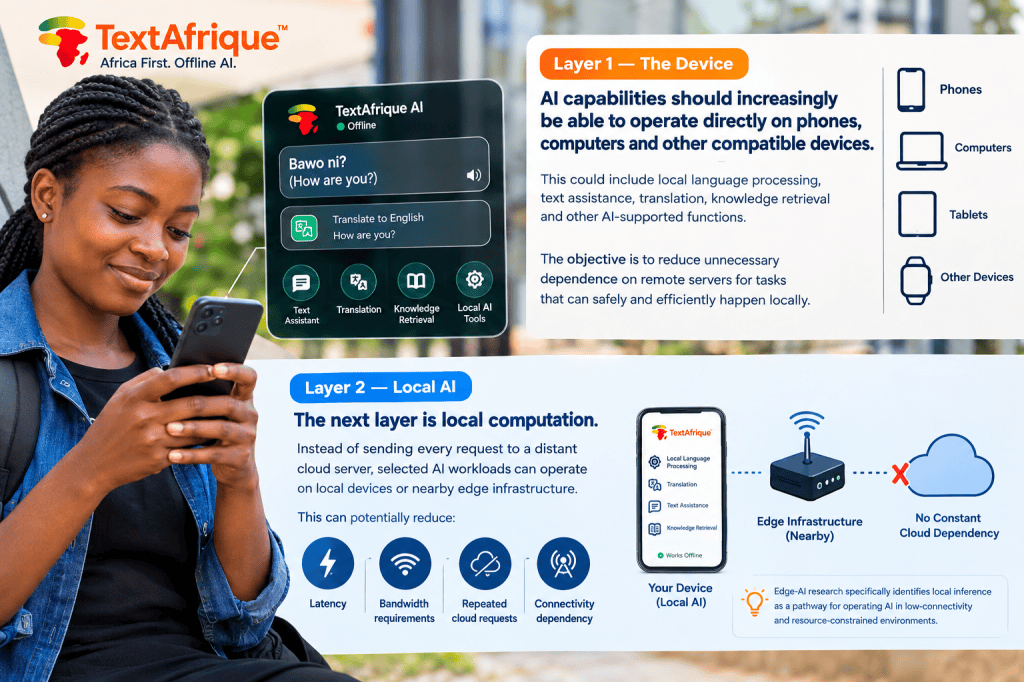
Layer 1 — The Device
AI capabilities should increasingly be able to operate directly on phones, computers and other compatible devices.
This could include local language processing, text assistance, translation, knowledge retrieval and other AI-supported functions.
The objective is to reduce unnecessary dependence on remote servers for tasks that can safely and efficiently happen locally.
Layer 2 — Local AI
The next layer is local computation.
Instead of sending every request to a distant cloud server, selected AI workloads can operate on local devices or nearby edge infrastructure.
This can potentially reduce:
- Latency
- Bandwidth requirements
- Repeated cloud requests
- Connectivity dependency
Edge-AI research specifically identifies local inference as a pathway for operating AI in low-connectivity and resource-constrained environments.
4. African Language Intelligence
Africa’s linguistic diversity must be treated as infrastructure—not an afterthought.
TextAfrique’s vision includes building technology that can increasingly understand and process African languages and communication patterns.
This means exploring technologies for:
Text → Speech → Translation → Understanding → Response
The objective is not simply to translate African languages into dominant global languages.
It is to create digital systems where African languages can become part of the technology itself.
Recent work involving African language AI demonstrates both the challenges and opportunities involved. UNICEF, for example, has supported projects involving local language data, model development and edge-AI approaches in West and Central Africa.
For TextAfrique, this represents an important principle:
African users should not have to leave their linguistic environment to access intelligent technology.

The Offline Knowledge Layer
Offline AI requires more than an AI model.
It requires knowledge.
TextAfrique’s long-term infrastructure can therefore evolve toward locally available knowledge repositories containing carefully curated information, documentation, educational resources, language resources and other useful datasets.
These resources could be periodically updated whenever connectivity becomes available.
The architecture could work conceptually like this:
Online → Synchronise → Store locally → Operate offline → Collect updates → Synchronise again
This creates a continuous knowledge cycle rather than a permanently online dependency.

6. Synchronisation: Connecting the Offline and Online Worlds
Offline does not have to mean disconnected forever.
The TextAfrique model can be designed around opportunistic synchronisation.
When a device or local node obtains connectivity, it can synchronise:
- Software updates
- AI model updates
- Knowledge packages
- Security updates
- User-authorised data
- System improvements
When connectivity disappears, the system can continue operating within its locally available capabilities.
This architecture is already being explored in other African infrastructure initiatives, where services are designed to operate locally and synchronise when connectivity returns.
7. Africa First. Offline AI.
TextAfrique’s long-term African blueprint is ultimately about access, resilience, language and technological sovereignty.
The goal is not to reject the cloud.
The goal is to make the cloud one part of a larger infrastructure.
A future where devices can think locally, communities can maintain local knowledge, businesses can continue operating during connectivity interruptions, and African languages can become first-class participants in the AI ecosystem.
That is the infrastructure opportunity.
That is the long-term direction.
And that is the idea behind TextAfrique — Africa First Offline AI.
TextAfrique™
Building technology around African realities.
Building intelligence beyond the cloud.
Building for what comes next.

Conclusion
TextAfrique’s blueprint begins with a simple principle: AI should not always depend on the cloud.
By bringing AI capabilities closer to the device and enabling selected workloads to run locally, Africa can build digital systems that are more responsive, adaptable and resilient to connectivity limitations.
From the device → to local AI → to edge infrastructure, TextAfrique is building toward an AI ecosystem designed around Africa’s realities.
Africa First. Offline AI.



Leave a comment